
- 8 times less weight and 4 times smaller than a conventional power supply.
- Sine wave operation reduces EMI and RFI.
- Operational frequencies up to 100 kHz.
- Efficiency is up to 95%.
- Over voltage and current protection.
- Lower EMI / RFI and switching loss due to zero volt switching.
- Winding capacitance is cancelled negating all high reactive currents.


Call Us:
+91-9822023486
+91-7020911390
Resonating Power Supply
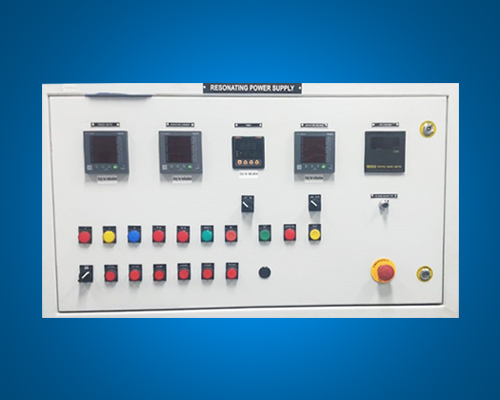
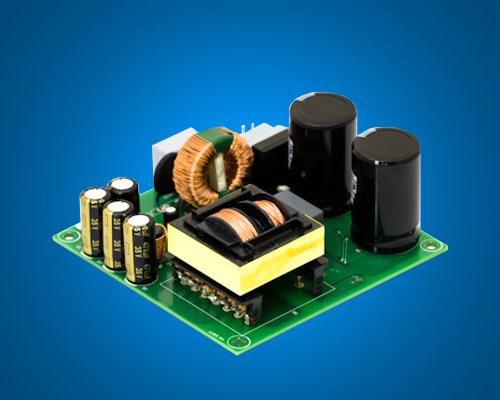
Resonating Power Supply
Switch-mode power supplies (SMPS) are known for their superior efficiency. And while they achieve a significant level of efficiency, the quest to improve it even further continues to march on. One development helping to attain that goal is resonant converters. These unique SMPS use resonant circuit techniques to reduce switching losses.
However, to receive any gains from resonant techniques requires a sophisticated controller. Now such controllers are available, and they feature additional power savings that further boost efficiency.
Switching transistors are vulnerable to significant losses, which occur during the turn-on and turn-off intervals. When the transistor is off, no power is dissipated. When the transistor is on, its low on-resistance keeps power dissipation to a minimum. During switching times, though, the transistors pass through their linear region where their resistance is higher, which means dissipation of power. Luckily the transition periods are short. Reducing the switching time substantially cuts down the power consumption.
The switching time is determined by the transistor’s specifications, but also by other circuit characteristics. Also, keep in mind that sharp pulse edge transitions produce transients that generate noise and electromagnetic interference (EMI). Therefore, a key goal in design is to reduce the switching time by using a higher switching frequency. Though EMI still occurs at faster switching rates, there’s a beneficial reduction in power consumption. Using resonant techniques can bring about that desired reduction in power consumption.
Advantages:
Uses:
- Suitable for any application that requires high voltage and high power, or lower voltage with very little noise.